Valse sentimentale, after Tchaikovsky
Film set to music by Pyotr Ilyich Tchaikovsky, Valse sentimentale, Op. 51 No. 6

Technical Details
- Medium: Digital film
- Duration: 2 min 11 s
- Image: 1920 × 1080 px, 25 fps
- Date: 2022
- Location: France
- Certificate of Authenticity: N°20221231-0071
- Catalogue Number: AQC0401
- Collection: Passé-Future
Provenance
- Origin: Arnaud Quercy, Paris, France, 2022
Description
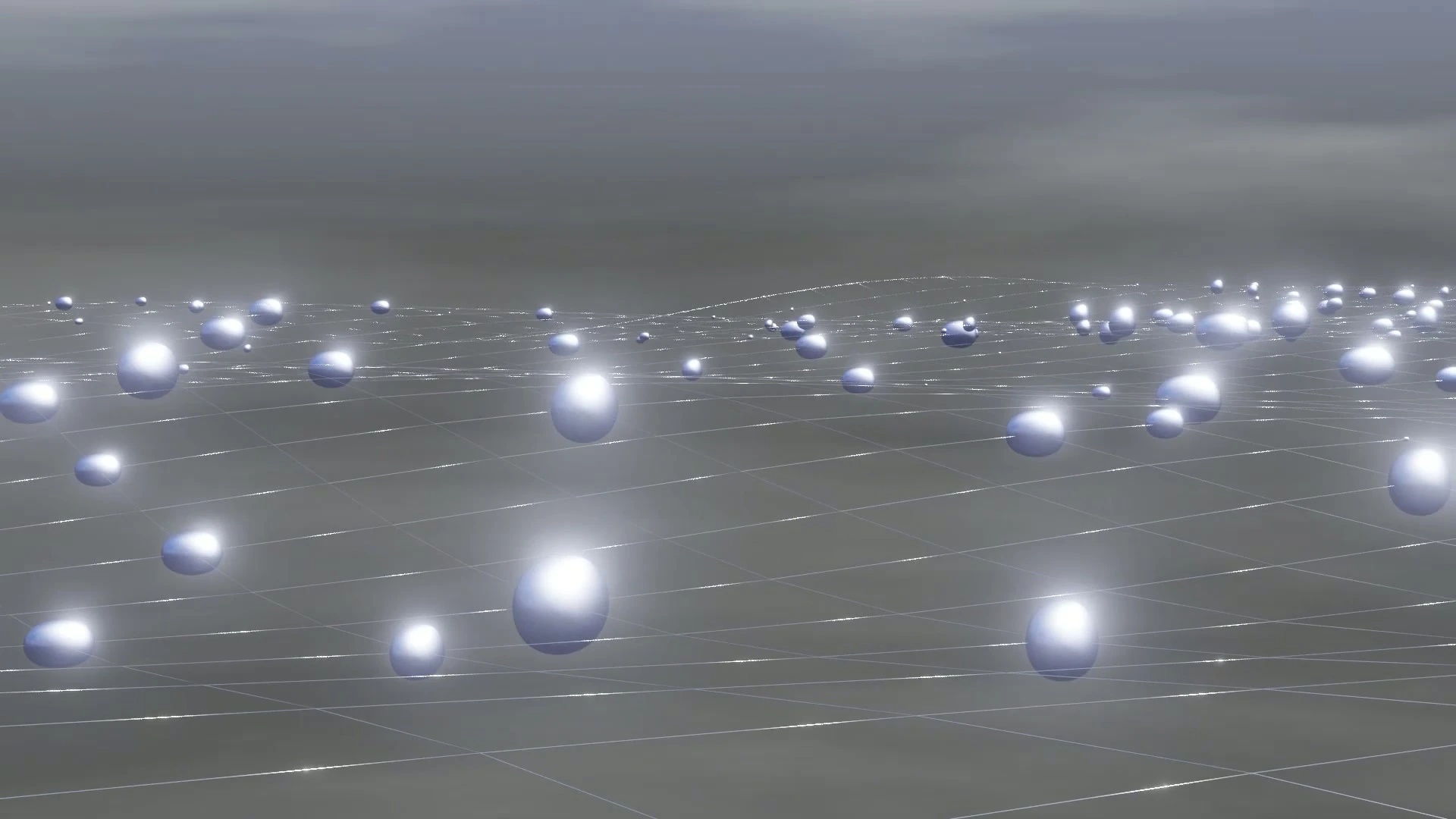
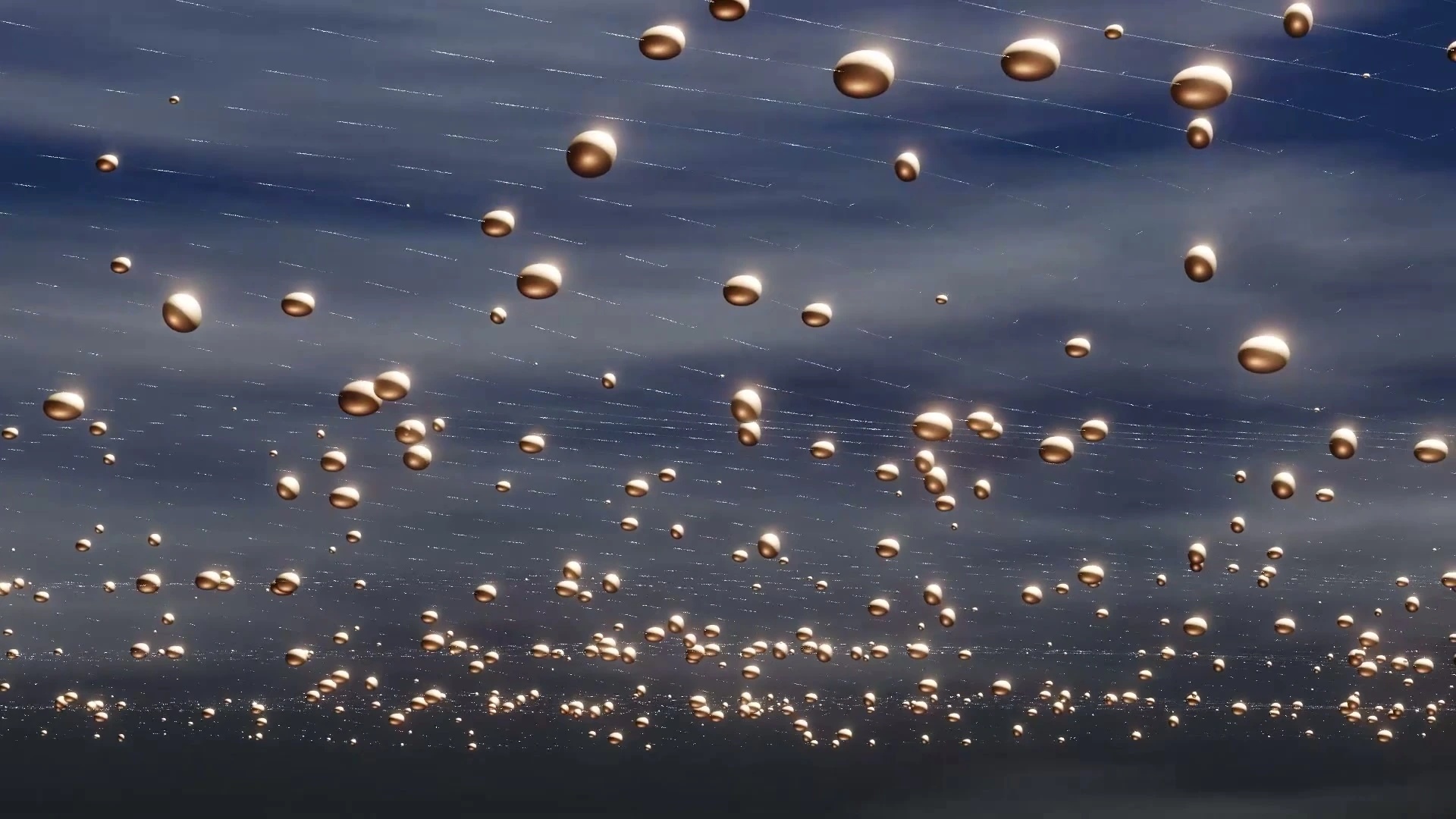
In his creation on the Valse sentimentale, Arnaud Quercy offers another of his surrealist and abstract creations. He stages the entry of flying balls into the sky. At first only a few points of light appear on the horizon of a dim, cloudy sky, while the title fades in. They multiply and come closer: luminous silver spheres, each one linked to, or trapped within, a wider web of fine lines stretched like a grid beneath and around them. They move as one, on a slow, invisible wave, symbolising the irresistible power of love.
As the symbol of unity and wholeness, the spheres illustrate the universe, or rather the universality of love, which can be infinite and without boundaries. Yet love is an emotional state we all experience at some point in our lives, and Arnaud questions unconditional love, for someone or for something. Reality often suggests some level of reciprocity, and bonds are a prerequisite to sustaining such love over time. The web is there to remind us of that.
Finally, Arnaud questions the effect of time. As the waltz goes on, daylight appears, and the density of the balls and the size of the web intensify. The spheres stretch into discs and change colour: from silver to green and gold, then copper, then a rosy red against a bright blue sky full of clouds, the moment where the "sentimental" waltz is at its warmest. Then the sky darkens to dusk. The balls turn into golden lights, like the lights of a city at night, and the whole web drifts away towards the horizon until only darkness remains. As the night closes the cycle, love and its web carry on with their journey.
The film was made in Blender (EEVEE) as one continuous camera move of 4,150 frames at 30 frames per second (2 min 18 s). The scene is very economical: a camera, a point light, an empty, a cube and a single animated plane, with a dotted-line material for the web. The hundreds of spheres are generated procedurally from these few objects, not placed by hand. The changes of colour come from an animated shader, and the plane is animated to give the slow wave. The film was then finished in Adobe After Effects (title, AQC signature, editing).
At the show, the long version of the film was projected. It is cut into two parts: a main section that can run on, and a closing section that Arnaud triggered live at a precise moment in the score, so that the image ends exactly with the music played by Marion Hedin and David Erhard.
Images
Where this work lives
- Collection: Passé-Future
Exhibitions
- PasséFutur Art Show (2022-09-30, L'Auguste Théâtre, Paris)
Thematic Elements
Technical Notes
- Type: Artwork
- Image resolution: 1920x1080 px
Page Information
- Last updated : 2026-11-06
- Language: EN | Version française