Jewish Song, after Bloch
Film set to music by Ernest Bloch, From Jewish Life, III. Jewish Song

Technical Details
- Medium: Digital film
- Duration: 2 min 43 s
- Image: 1920 × 1080 px, 25 fps
- Date: 2022
- Location: France
- Certificate of Authenticity: N°20221231-0078
- Catalogue Number: AQC0408
- Collection: Passé-Future
Provenance
- Origin: Arnaud Quercy, Paris, France, 2022
Description
In his creation on Jewish Song, Arnaud Quercy sets the music in an almost black-and-white world of greys and sepia, and lets only a few colours speak. He wants to amplify Bloch's mastery through this contrast of colour and symbol.
The film opens on a misty horizon above a flight of steps. A single white door stands there, alone, with a small red sphere rising beside it. There are many doors in our lives, from thresholds to the front door at home, but the door Arnaud sets at the very beginning is one that comes with a sense of promise and freedom. Later the door comes back, dark and slightly open, with light shining from underneath.
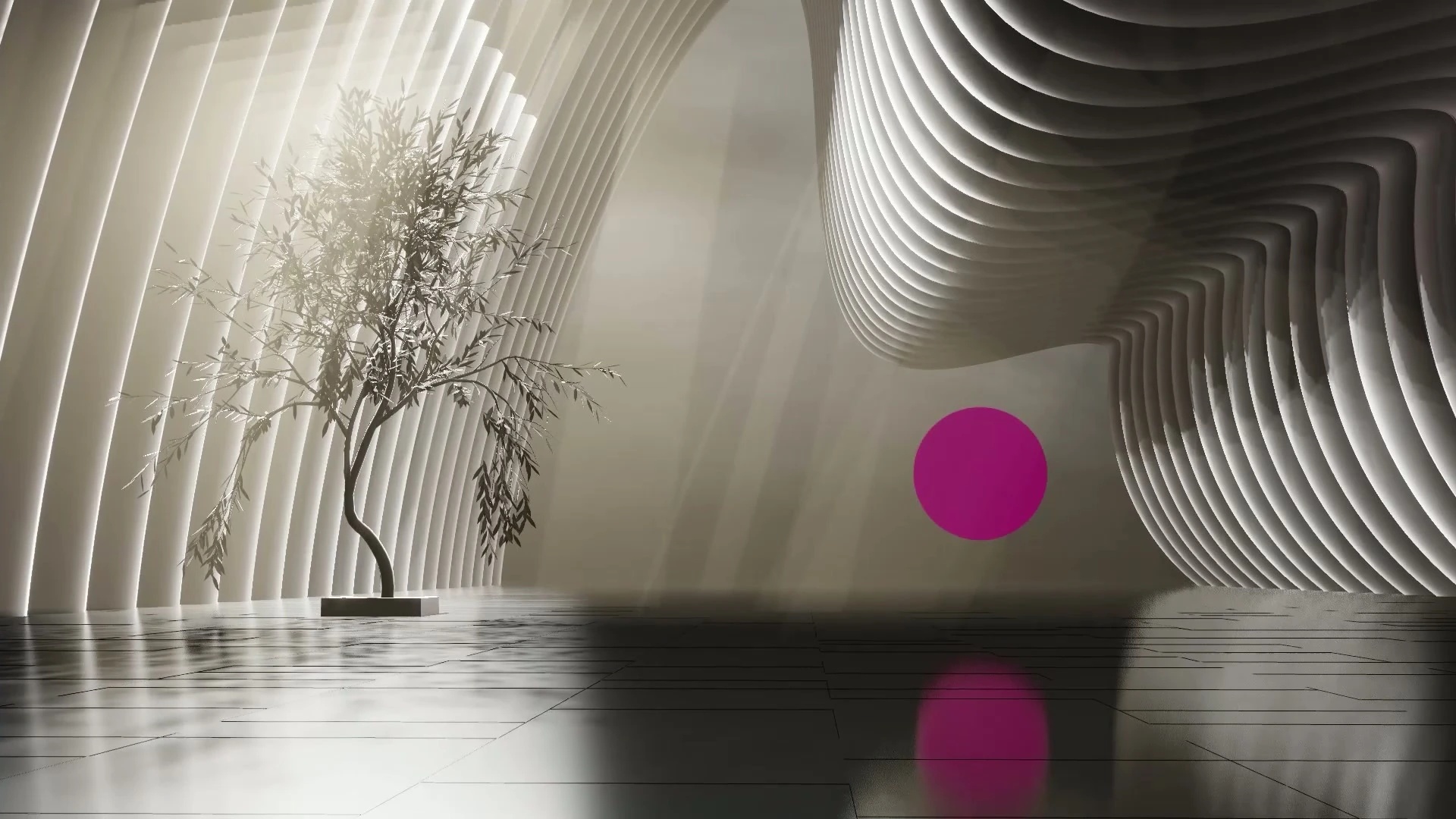
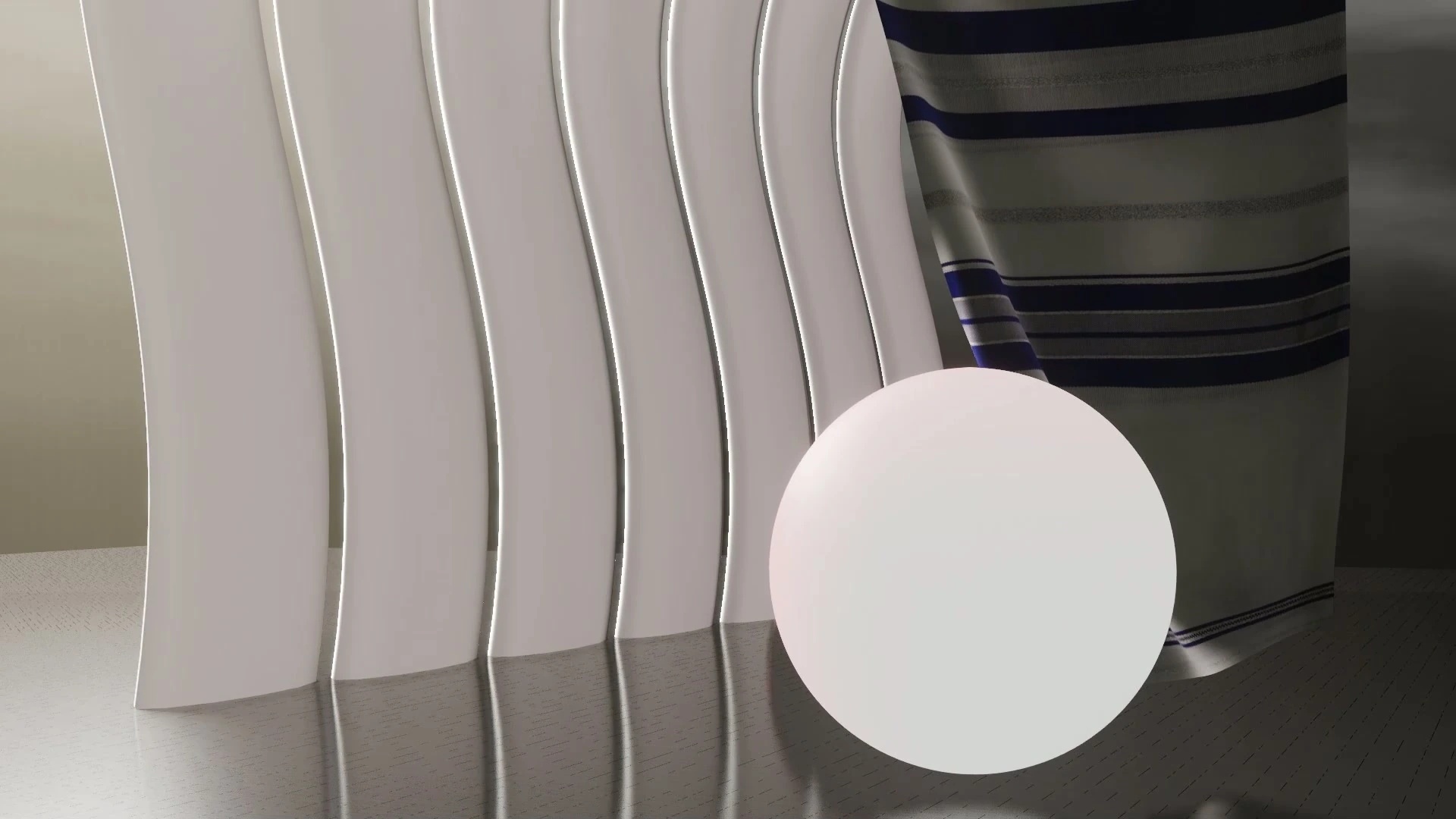
The film then alternates between a few recurring scenes that dissolve into one another. In the first, a white prayer shawl (tallit) with blue stripes floats and ripples in the wind beside a tall, glowing white sphere, in front of a wall of undulating white ribs. In the second, the camera moves through a temple-like space of curved, flowing arches, where the red sphere hangs above a dark, reflecting floor. In the third, a tree stands in shallow water beneath the arches. A tree is a reminder of life, growth and fertility, but also a symbol of the cycle of life and death. Beside it, the small sphere is no longer red but purple. The shawl, the white sphere, the arches and the tree keep returning, like the verses of a song.
Colours have meaning in Jewish culture, because they bring memories and feelings to mind: white (zen/purity), gold (meaningfulness/joy), black (mourning), red (life/pleasure), purple (purification from sin), blue (Judaism). In the film they appear as the white of the sphere and the shawl, the black of the deep shadows, the red sphere that turns purple, and the blue stripes of the tallit. The way the coloured spheres move links them to deep spirituality, and can highlight what you believe in or who you are.
In this surrealist pairing of unholy and holy worlds, Arnaud is trying to address something more human than anything else: faith.
The film was made in Blender (EEVEE). The prayer shawl is a cloth simulation textured with a photograph of a real tallit, blown by wind and turbulence force fields and colliding with the large sphere. The arches and ribbed walls of the "temple" are Bezier curves repeated with array modifiers, the door and the stairs are modelled objects, and a volume of fog fills the space. The colour of the small sphere is animated in its shader, from red to purple. The 4,000 rendered frames were assembled in Adobe After Effects with cross-dissolves between the scenes, and the title was added there.
At the show, the long version of the film was projected. It is cut into two parts: a main section that can run on, and a closing section that Arnaud triggered live at a precise moment in the score, so that the image ends exactly with the music played by Marion Hedin and David Erhard.
Images
Where this work lives
- Collection: Passé-Future
Exhibitions
- PasséFutur Art Show (2022-09-30, L'Auguste Théâtre, Paris)
Thematic Elements
Technical Notes
- Type: Artwork
- Image resolution: 1920x1080 px
Page Information
- Last updated : 2026-11-06
- Language: EN | Version française